
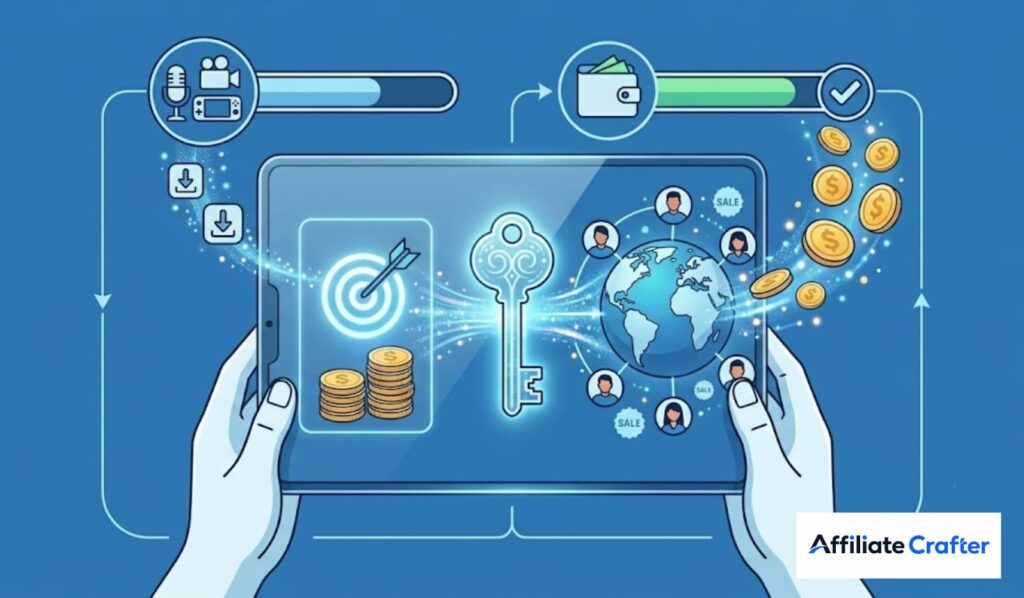
Learning how to become an affiliate marketer is one of the most searched questions in the online business world right now — and for good reason. According to Statista, the global affiliate marketing industry is projected to reach $27.78 billion by 2027, growing at a healthy clip year over year. In the United States alone, affiliate marketing spending exceeded $10 billion in 2024, making it one of the most reliably profitable digital business models available to beginners today.
But here’s the honest truth most guides skip: affiliate marketing is not a get-rich-quick scheme. It’s a learnable, buildable skill set — and when you execute it correctly, it generates income that compounds over time. People around the world from Australia to Germany, from India to Canada, are building genuinely sustainable online businesses through affiliate marketing every single day.
This guide covers everything — from the absolute basics of affiliate marketing 101 to advanced strategies for scaling your income. Whether you’ve never made a dollar online or you’re ready to take a side hustle seriously, this is the blueprint you need.
Table of Contents
- What Is Affiliate Marketing?
- How Affiliate Marketing Works — Step by Step
- Affiliate vs Partner Marketing — What’s the Difference?
- Why Affiliate Marketing Is Still Worth It in 2025
- Step 1 — Choose Your Niche
- Step 2 — Choose Your Platform
- Step 3 — Find and Join Affiliate Programs
- Step 4 — Create Content That Converts
- Step 5 — Drive Traffic to Your Content
- Step 6 — Build Your Email List
- Step 7 — Track, Optimize, and Scale
- Affiliate Marketing Without a Website
- How Much Money Can You Make?
- Common Affiliate Marketing Mistakes to Avoid
- Expert Insights & Real-World Examples
- Statistics & Data
- FAQs
- Key Takeaways & CTA
What Is Affiliate Marketing?
Affiliate marketing is a performance-based business model where an individual (the affiliate) earns a commission by promoting another company’s product or service. When a customer purchases through the affiliate’s unique tracking link, the affiliate earns a percentage of the sale or a fixed fee. No product creation, inventory, or customer support is required.
Think of it as referral marketing at scale. A travel blogger recommends a hotel booking platform. A tech YouTuber reviews a software tool. A fitness influencer promotes a supplement brand. All three earn a commission every time their audience buys through their link — often while they sleep.
The three core parties in every affiliate relationship:
| Party | Role |
|---|---|
| Merchant / Advertiser | Creates and sells the product or service |
| Affiliate / Publisher | Promotes the product and drives traffic |
| Customer | Clicks the affiliate link and makes a purchase |
A fourth party — the affiliate network — often sits between merchant and affiliate, managing tracking, payments, and program administration.
How Affiliate Marketing Works — Step by Step
Understanding the mechanics clearly helps you avoid confusion later. Here’s exactly what happens in a standard affiliate transaction:
- You join an affiliate program and receive a unique tracking link (URL)
- You create content — a blog post, video, social media post, or email — featuring that link
- A visitor clicks your link and lands on the merchant’s website
- A cookie is stored on the visitor’s browser, tracking that you referred them (cookie duration varies: 1 to 90+ days)
- The visitor makes a purchase (or completes another desired action — a signup, a trial, a form fill)
- The merchant’s tracking system records the conversion and attributes it to your link
- You earn a commission — paid monthly, bi-weekly, or on a threshold basis depending on the program
This process runs automatically. Once your content ranks, converts, or gets shared — commissions accumulate without you manually doing anything.
Affiliate vs Partner Marketing — What’s the Difference?
These terms are often used interchangeably, but they’re not identical. Understanding the distinction helps you position yourself and your business correctly.
| Dimension | Affiliate Marketing | Partner Marketing |
|---|---|---|
| Relationship type | Transactional | Strategic |
| Compensation | Commission per sale/action | Revenue share, co-marketing, licensing |
| Access level | Limited (tracking link, assets) | Deep (product roadmap, integrations) |
| Volume required | Any traffic level | Usually enterprise or high-volume |
| Common platforms | ShareASale, CJ, ClickBank | PartnerStack, Impact |
For most beginners, affiliate marketing is the right starting point. Partner marketing evolves naturally as your audience and revenue grow. To explore the full comparison, see our dedicated guide on affiliate marketing vs. partner marketing.
Why Affiliate Marketing Is Still Worth It in 2025
Some people will tell you affiliate marketing is dead. They’re wrong — and the data is clear about that.
Furthermore, the way people discover products has fundamentally shifted. Consumers now trust independent reviews, YouTube tutorials, and newsletter recommendations far more than they trust branded advertising. That trust gap is exactly where affiliate marketers thrive.
Additionally, the rise of AI-powered search has increased demand for expert, experience-driven content — precisely what good affiliates produce. Google’s EEAT framework (Experience, Expertise, Authoritativeness, Trustworthiness) now rewards the kind of real-world, first-hand content that affiliate marketers naturally create.
Consider these signals that affiliate marketing is not just alive but accelerating:
- 80% of brands worldwide run an affiliate marketing program (Rakuten Advertising)
- Affiliate marketing drives 16% of all e-commerce sales in the United States
- The average affiliate marketer earns between $8,000 and $80,000 per year depending on niche, platform, and traffic
- Top-tier affiliate marketers earn $100,000+ per month — case studies from Pat Flynn (Smart Passive Income), Michelle Schroeder-Gardner (Making Sense of Cents), and Spencer Haws (Niche Pursuits) confirm this at scale
Step 1 — Choose Your Niche
Your niche determines everything that follows — your audience, your content, your affiliate programs, and ultimately your income ceiling.
What Makes a Good Affiliate Niche?
A profitable niche balances three factors:
1. Your interest and knowledge — Sustainability matters. If you genuinely don’t care about your niche, producing 50+ pieces of content over 18 months becomes painful. Pick something you can speak about with authentic experience.
2. Audience demand — There must be people actively searching for information and solutions in your niche. Keyword research tools like Ahrefs, SEMrush, and Google Keyword Planner quantify this demand before you commit.
3. Monetization potential — The niche must have products or services that pay meaningful commissions. Software (SaaS) and financial products consistently offer the highest commissions — often 20–50% recurring on monthly subscriptions.
High-Potential Niches for 2025
| Niche | Why It Works | Example Programs |
|---|---|---|
| Personal finance | High purchase intent, evergreen | Credit Karma, NerdWallet affiliates |
| Software / SaaS | Recurring commissions (20–40%) | HubSpot, Shopify, ConvertKit |
| Health & wellness | Massive audience, strong demand | Healthline affiliates, supplement brands |
| Travel | High ticket values, good cookie windows | Booking.com, Expedia, TripAdvisor |
| Online education | Growing demand, digital products | Coursera, Teachable, Udemy |
For a deep dive into evaluating profit potential, read our guide on how to choose a profitable affiliate niche.
Step 2 — Choose Your Platform
Before joining a single affiliate program, decide where you’ll publish your content. Your platform shapes your audience, your content format, and your growth timeline.
Option A — Blog / Website
A blog is the single most powerful long-term affiliate platform because it compounds over time. Content you publish today can rank on Google and generate commissions for years. SEO-driven affiliate blogs are the foundation of most six-figure affiliate businesses.
Advantages:
- Passive traffic from search engines
- Full control over your content and audience
- Builds domain authority over time
- Best platform for in-depth product reviews and comparison content
Timeline: Typically 6–18 months to meaningful organic traffic. Patience is essential.
Option B — YouTube Channel
Video reviews, tutorials, and comparison videos convert exceptionally well. YouTube is the world’s second-largest search engine — and it sends warm, high-intent traffic to affiliate links in video descriptions.
Advantages:
- Strong conversion rates (viewers are already warm to recommendations)
- Lower text-writing requirement
- YouTube handles hosting and discoverability
Platforms like Instagram, TikTok, and Pinterest work particularly well for visual niches — fashion, beauty, home décor, travel. Short-form video has dramatically lowered the barrier to audience building.
Email marketing consistently delivers the highest affiliate conversion rates of any channel. An email list of 5,000 engaged subscribers often outperforms a blog with 50,000 monthly visitors. However, you need a platform first to build the list.
For affiliates who don’t want to build a website, we cover those paths in detail in our guide on affiliate marketing without a website.
Step 3 — Find and Join Affiliate Programs
Not all affiliate programs are equal. Commission rates, cookie windows, payment terms, and product quality vary dramatically. Here’s how to evaluate them intelligently.
Three Types of Affiliate Programs
Direct affiliate programs — Companies run their own in-house programs. You apply directly on their website. Examples: HubSpot Affiliate Program, Shopify Affiliate Program, Fiverr Affiliates.
Affiliate networks — Marketplaces that host thousands of merchant programs under one roof. You join once and access hundreds of programs. Examples: ShareASale, CJ Affiliate (Commission Junction), Rakuten Advertising, Awin, Impact.
Digital product marketplaces — Platforms focused on digital products (courses, software, ebooks). Examples: ClickBank, JVZoo, Digistore24. These typically offer the highest commission rates (40–75%) but quality varies.
Best Affiliate Programs for Beginners
| Program | Category | Commission | Cookie Window |
|---|---|---|---|
| Amazon Associates | E-commerce (everything) | 1–10% | 24 hours |
| ShareASale | Network (multi-niche) | Varies | Varies |
| HubSpot | CRM / Marketing Software | 30% recurring | 90 days |
| Shopify | E-commerce platform | $150 per referral | 30 days |
| ConvertKit | Email marketing | 30% recurring | 60 days |
| ClickBank | Digital products | 40–75% | 60 days |
| Impact | Network (top brands) | Varies | Varies |
| PartnerStack | B2B SaaS | 15–40% recurring | 90 days |
For detailed program reviews and current commission structures, explore our guide to what are the best affiliate programs for beginners.
Step 4 — Create Content That Converts
Content is the engine of every affiliate marketing business. However, not all content converts equally. Understanding which content formats drive affiliate sales is one of the most valuable skills you can develop.
The Five Highest-Converting Affiliate Content Formats
1. Product Reviews Honest, experience-based reviews of specific products or services. These capture searchers with high buying intent — people searching “[Product Name] review” are already close to a purchase decision. Consequently, review content often converts at 3–5× the rate of informational content.
2. Comparison Articles “X vs Y” comparisons (e.g., “Shopify vs WooCommerce,” “ConvertKit vs Mailchimp”) capture readers in the final evaluation stage. They’re researching their last two options before buying. Additionally, comparison content ranks well because few publishers do it thoroughly.
3. Best-of Lists “Best [Product Category] for [Audience]” articles rank well for high-volume terms and allow you to promote multiple affiliate products simultaneously.
4. Tutorials and How-To Content Teaching someone how to use a product naturally incorporates your affiliate link. Moreover, tutorials build trust and authority — essential ingredients for conversion.
5. Resource Pages A curated list of your recommended tools in one place. Resource pages generate consistent passive commissions from readers who return repeatedly.
The EEAT Content Framework
Google’s EEAT guidelines reward content that demonstrates real experience, genuine expertise, authoritativeness in the niche, and trustworthiness in recommendations. Practically, this means:
- Writing from firsthand experience with the products you recommend
- Disclosing your affiliate relationships transparently (legally required in the US, UK, Canada, and most markets)
- Citing sources and data to support claims
- Publishing an “About” page that establishes your credentials
Step 5 — Drive Traffic to Your Content
Creating content is only half the equation. Traffic is how content becomes commissions.
SEO — The Long Game That Pays Forever
Search engine optimization remains the highest-ROI traffic source for affiliate marketers over a 12–36 month horizon. When your article ranks on page one of Google for a buyer-intent keyword, it generates clicks around the clock — without ongoing advertising spend.
The three pillars of affiliate marketing SEO:
- Keyword research — Target terms with meaningful search volume and buyer intent. Focus on long-tail keywords (3+ words) with lower competition. To learn more about this in depth, explore our guide on SEO for affiliate marketing.
- On-page optimization — Title tags, header structure, internal linking, page speed, and content depth all influence rankings
- Backlinks — Links from other websites to yours increase domain authority and ranking ability
Social media platforms — particularly TikTok, Pinterest, and Instagram — allow you to reach audiences before you have SEO traction. A single viral post can generate hundreds of affiliate clicks overnight. For platform-specific tactics, read more on affiliate marketing using social media.
Paid Traffic — Fast but Requires Capital
Pay-per-click advertising (Google Ads, Meta Ads) can accelerate affiliate income — but it requires careful margin management. The economics must work: your commission per conversion must exceed your cost per click × conversion rate.
Step 6 — Build Your Email List
Of all the affiliate marketing strategies available, building an email list is the one most beginners delay too long. Don’t make that mistake.
Email gives you a direct, algorithm-independent line to your audience. When your social media reach drops or a Google update hurts your rankings, your email list remains yours. Furthermore, email subscribers convert at 3–6× the rate of cold traffic because they already trust you.
How to Start Building Your Email List
- Choose an email platform — ConvertKit, Mailchimp, ActiveCampaign, or AWeber all offer free plans for beginners
- Create a lead magnet — a free resource (checklist, mini-course, template, guide) that visitors trade their email address to receive
- Add opt-in forms to your highest-traffic pages
- Send a welcome sequence — a series of 3–7 emails that builds trust and introduces your best content
- Promote affiliate products contextually in your regular newsletter sends
For advanced list-building and promotional strategies, see our complete guide on affiliate marketing with email lists.
Step 7 — Track, Optimize, and Scale
Most beginner affiliates publish content and hope for commissions. Professional affiliates track everything and optimize relentlessly.
Essential Metrics to Track
| Metric | What It Tells You |
|---|---|
| Click-through rate (CTR) | How compelling your affiliate link placements are |
| Conversion rate | How well the merchant’s page converts your traffic |
| Earnings per click (EPC) | True profitability per visitor sent |
| Average order value | Whether to focus on volume or higher-ticket products |
| Cookie window impact | How many conversions happen days after the initial click |
Most affiliate networks provide dashboards with these metrics. Additionally, tools like Google Analytics 4, Pretty Links, and ThirstyAffiliates help you track clicks and performance on your own site.
When to Scale
Scaling affiliate income means replicating and amplifying what works. Once you identify a content format, keyword type, or traffic channel that consistently converts, systematically produce more of it. For a detailed roadmap, read our guide on how to scale affiliate marketing revenue.
Affiliate Marketing Without a Website
Many people believe a blog or website is a prerequisite for affiliate marketing. It isn’t. While a website is the most powerful long-term foundation, several effective alternatives exist:
YouTube Channel — Link affiliate products in video descriptions. YouTube’s built-in search drives consistent, high-intent traffic to monetized video content.
TikTok / Instagram / Pinterest — Short-form and visual content can drive significant affiliate traffic, especially in lifestyle, fashion, and beauty niches. Many platforms now allow affiliate links directly in posts or bios.
Email Newsletter — Build a list through a landing page and promote affiliate products via broadcast emails. No website required for the basic setup.
Quora / Reddit — Answer questions in your niche and naturally mention products (with full disclosure). Some affiliates generate meaningful commissions purely through community engagement.
Podcast — Mention affiliate products verbally with a custom promo code. Podcasts build intimate audience trust — conversion rates are often higher than blog content.
How Much Money Can You Make From Affiliate Marketing?
This is the question every beginner asks first. The honest answer: it varies enormously based on niche, traffic, platform, and consistency.
Realistic Income Benchmarks
| Stage | Monthly Income | Timeline | Characteristics |
|---|---|---|---|
| Beginner | $0–$500 | Months 1–6 | Learning, building content, minimal traffic |
| Growing | $500–$2,000 | Months 6–18 | SEO gains, email list building |
| Intermediate | $2,000–$10,000 | Months 12–36 | Multiple traffic sources, audience trust established |
| Advanced | $10,000+ | 2–5 years | Authority site, team, multiple programs |
| Expert | $100,000+/mo | 3–10 years | Pat Flynn, Michelle Schroeder-Gardner, Niche Pursuits scale |
For a detailed breakdown of income potential, income streams, and realistic expectations by niche, read our full guide on how much money can you make from affiliate marketing.
Common Affiliate Marketing Mistakes to Avoid
Even talented marketers make avoidable errors when starting out. Therefore, knowing these pitfalls in advance saves months of wasted effort.
1. Promoting products you haven’t used Recommending something you haven’t experienced destroys credibility when readers follow your advice and get a poor result. Experience-based reviews consistently outperform manufactured ones.
2. Targeting keywords that are too competitive Beginners often chase high-volume, high-competition keywords and get zero traffic. Instead, target long-tail keywords (500–2,000 monthly searches, low difficulty) and build authority progressively.
3. Joining too many affiliate programs simultaneously Spreading yourself across 15 programs before you’ve driven meaningful traffic to any of them is a common trap. Focus on 2–3 programs in your niche and master them first.
4. Ignoring FTC disclosure requirements In the United States, FTC guidelines require clear disclosure of affiliate relationships. The UK’s ASA has equivalent requirements. Failing to disclose not only risks penalties — it erodes reader trust when discovered.
5. Neglecting email list building early Social algorithms change. Google updates rankings. An email list is the one audience you actually own. Building it from day one is the single most impactful early decision an affiliate can make.
6. Giving up before the 12-month mark Most affiliate businesses don’t generate meaningful income in the first 6 months. The natural growth curve requires time — particularly for SEO-driven blogs. Affiliates who quit at month 4 never see the results that months 12–18 would have delivered.
For a complete breakdown of what not to do, explore our dedicated article on common affiliate marketing mistakes.
Expert Insights & Real-World Examples
What Separates Successful Affiliates From Everyone Else
After studying hundreds of affiliate businesses, certain patterns emerge consistently:
They pick one platform and master it first. Pat Flynn (Smart Passive Income) built his initial audience exclusively through a blog before expanding. Spencer Haws (Niche Pursuits) built authority sites to six figures before launching courses. The temptation to be everywhere is exactly what keeps most beginners stuck.
They treat affiliate marketing like a business, not a lottery ticket. Sustainable income requires content calendars, keyword research processes, email sequences, and performance tracking. The affiliates earning $10,000+ per month treat their operation with the same discipline as any other business.
They prioritize audience trust above short-term commission maximization. Recommending a slightly lower-commission product that genuinely serves readers better always wins long-term. Audience trust compounds — it doesn’t erode. That’s the core insight that separates how to make money with affiliate marketing sustainably versus chasing quick commissions.
Real-World Example: The Software Review Blog
A software blogger in the project management niche publishes 60 comparison articles over 18 months. Each article targets a “Software A vs Software B” keyword. At month 18, 12 articles rank on Google’s first page for their target keyword. Those 12 articles collectively drive 8,000 monthly organic visitors. At a 3% conversion rate and $50 average commission per sale, the site generates $12,000/month — almost entirely passively.
This isn’t hypothetical. It’s the standard playbook for SaaS affiliate blogs in 2025, and it works because the content answers exactly what buyers need at the decision stage.
Statistics & Data
- The affiliate marketing industry is worth $17 billion globally in 2024 (Influencer Marketing Hub)
- Global affiliate spending is projected to reach $27.78 billion by 2027 (Statista)
- 80% of brands worldwide use affiliate marketing programs (Rakuten Advertising)
- Affiliate marketing drives 16% of all US e-commerce revenue (Business Insider Intelligence)
- 38% of marketers rank affiliate marketing as one of their top customer acquisition channels (Forrester Research)
- The average affiliate marketer earns $8,038/year at the beginner level, scaling to $80,000+ for established affiliates (Authority Hacker survey, 2024)
- Email marketing delivers an average ROI of $36 for every $1 spent — the highest of any digital marketing channel (Litmus, 2023)
- 92% of consumers trust recommendations from individuals over brand advertising (Nielsen Global Trust in Advertising Report)
- Amazon Associates has over 900,000 affiliate members globally
- ClickBank has paid out over $6 billion in commissions since its founding
FAQs — How to Become an Affiliate Marketer
Q: What is affiliate marketing in simple terms? Affiliate marketing is when you promote someone else’s product online and earn a commission when someone buys through your unique link. You don’t create or own the product — you recommend it and get paid for driving sales.
Q: How do beginners start affiliate marketing? Beginners should choose a niche they understand, select a content platform (blog, YouTube, or social media), join relevant affiliate programs, create helpful content featuring affiliate links, and drive traffic through SEO or social media. Consistency over 12–18 months is what separates earners from quitters.
Q: Can you do affiliate marketing without a website? Yes. YouTube, TikTok, email newsletters, Pinterest, and podcast platforms all support affiliate marketing without a traditional website. However, a blog or website provides the most sustainable, compounding traffic over time.
Q: How much money can you make from affiliate marketing? Income ranges from $0 to $100,000+ per month depending on niche, traffic, and experience. Beginners typically earn $0–$500/month in the first six months. Established affiliates with SEO authority and email lists commonly earn $5,000–$20,000/month.
Q: Is affiliate marketing still profitable in 2025? Absolutely. The industry is growing year over year and is projected to reach $27.78 billion by 2027. As consumer trust in brand advertising declines, trust in independent content creators increases — directly benefiting affiliate marketers.
Q: What are the best affiliate programs for beginners? Amazon Associates, ShareASale, CJ Affiliate, and ClickBank are accessible entry points. For higher commissions, SaaS programs like HubSpot, ConvertKit, and Shopify offer 20–40% recurring commissions with 30–90 day cookie windows.
Q: How long does it take to make money with affiliate marketing? Most affiliates with an SEO-focused blog see their first meaningful income between months 6–12. Social media and email-based affiliates can see results faster — sometimes within weeks — if they already have an audience.
Q: What skills do you need for affiliate marketing? Core skills include basic content writing, keyword research, SEO fundamentals, and email marketing. Over time, skills like conversion rate optimization, paid traffic management, and analytics interpretation become valuable. None of these require formal education — all can be self-taught.
Q: Do I need to disclose affiliate links? Yes. In the United States, FTC regulations require clear disclosure. The UK’s ASA, Canada’s CRTC, and most European regulators have equivalent rules. Include a disclosure statement on your website and near every piece of content containing affiliate links.
Q: What is the difference between affiliate marketing and dropshipping? Affiliate marketing requires no inventory, no order fulfillment, and no customer service. You earn a commission on sales you refer. Dropshipping requires you to manage an online store, process orders, and handle customer service — though you don’t physically hold inventory. For a full breakdown, see our guide on affiliate marketing vs dropshipping.
Q: How do I choose the right affiliate niche? Choose based on three factors: genuine personal interest, demonstrated audience demand (verified through keyword research), and strong monetization potential. Software, finance, and health consistently offer the best commission structures. For detailed guidance, see how to choose a profitable affiliate niche.
Q: Can I do affiliate marketing with social media alone? Yes. TikTok creators, Instagram influencers, and Pinterest marketers generate consistent affiliate income using only social platforms. The limitation is algorithm dependence — building an email list or website alongside social reduces that risk significantly.
Key Takeaways
- Affiliate marketing is a performance-based business model where you earn commissions by promoting other companies’ products through tracked links
- Niche selection determines your content direction, program options, and income ceiling — choose based on interest, demand, and monetization potential
- Your platform (blog, YouTube, email, social media) shapes your growth timeline — SEO-driven blogs compound long-term; social grows faster initially
- Content quality driven by firsthand experience, honest recommendations, and EEAT principles outperforms keyword-stuffed thin content in every metric
- Email list building from day one is the highest-leverage decision beginners consistently delay too long
- Realistic timeline: 6–18 months to meaningful income for most affiliates using SEO; faster for those with existing audiences
- Biggest mistake: quitting before the 12-month mark, when most SEO-driven affiliate sites just begin gaining traction
- Top programs for beginners: Amazon Associates, ShareASale, HubSpot, Shopify, and ClickBank
- Consistent tracking and optimization — not just content creation — separates six-figure affiliates from stuck beginners
Ready to Start Your Affiliate Marketing Journey?
You now have a complete, step-by-step roadmap for exactly how to become an affiliate marketer in 2025. The knowledge is here. The strategy is clear. All that remains is the decision to start.
Here’s the honest reality: the affiliates earning $10,000, $50,000, and $100,000 per month didn’t stumble onto a secret formula. They picked a niche, showed up consistently, built audience trust over time, and kept optimizing. Every single one of them started exactly where you are right now — at the beginning.
Affiliate Crafter exists to make that beginning faster, clearer, and more profitable. From niche research frameworks and program directories to deep-dive content strategy guides and income scaling blueprints — everything you need to build a real affiliate business is here.
The market is growing. Audiences are hungry for trusted recommendations. The opportunity is genuinely open right now for new affiliates who commit to doing it correctly.
Your first commission is closer than you think.
Ask AI about this post